Asian Gateway Launches FS Toward JCM Implementation of Rice-Husk Biochar in Cambodia
Selected for METI’s Global South Future-Oriented Co-Creation Program; Grant Approval Received
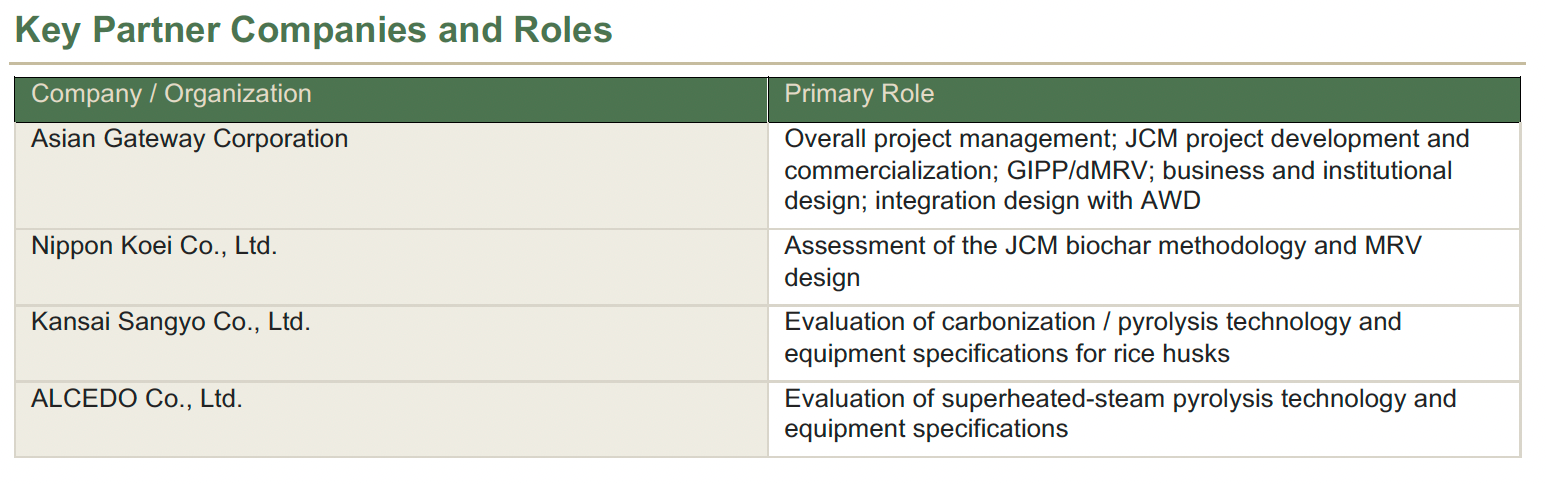
— In collaboration with Nippon Koei, Kansai Sangyo and ALCEDO, exploring an integrated AWD, biochar and dMRV model —
In Battambang Province, the project will assess rice-husk biochar production and field application, together with JCM MRV. In coordination with a MAFF-selected AWD/dMRV FS, Asian Gateway will explore an integrated “AWD × Biochar × dMRV” model in the same paddy fields, aiming to improve agricultural productivity, reduce GHG emissions, enhance carbon storage, and generate carbon credits under applicable schemes and methodologies.
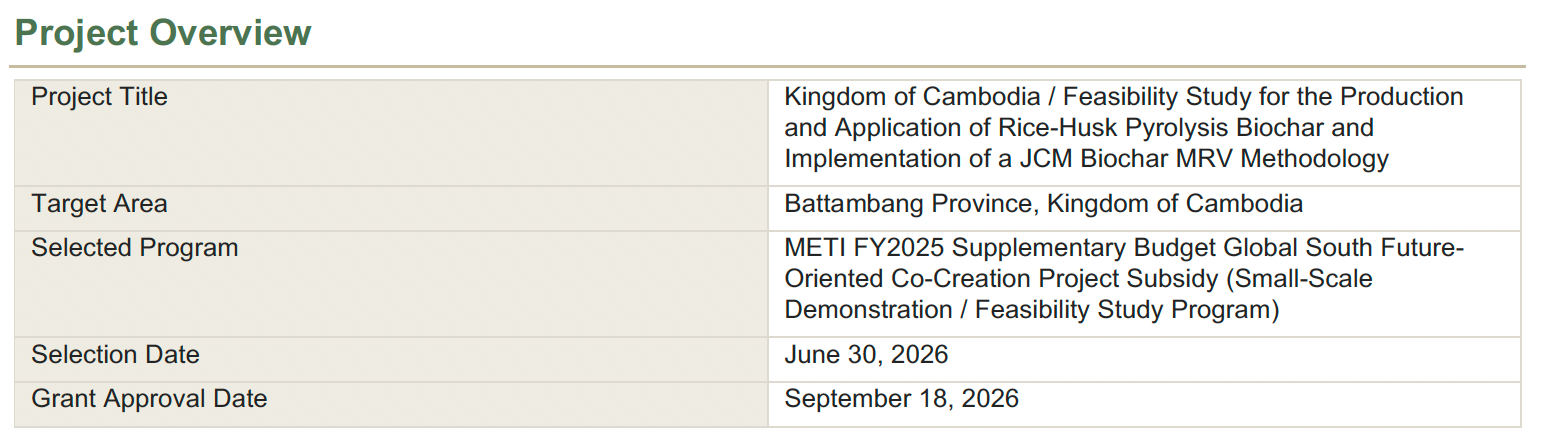
Asian Gateway Corporation (Head Office: Chiyoda-ku, Tokyo; Representative Director and President: Tomonori Kimura; “Asian Gateway”) announces that its proposed project, “Kingdom of Cambodia / Feasibility Study for the Production and Application of Rice-Husk Pyrolysis Biochar and Implementation of a JCM Biochar MRV Methodology,” was selected under the Ministry of Economy, Trade and Industry (METI) FY2025 Supplementary Budget Global South Future-Oriented Co-Creation Project Subsidy (Small-Scale Demonstration / Feasibility Study Program). The project was selected on June 30, 2026 and received grant approval on September 18, 2026.
The project is a feasibility study (FS) in Battambang Province, Kingdom of Cambodia, to assess the commercial implementation potential of an integrated value chain that converts rice husks generated by rice milling into biochar through pyrolysis, applies the biochar to farmland, implements MRV (measurement, reporting and verification), and prepares for potential JCM crediting. The FS will examine feedstock supply, pyrolysis technology, biochar quality, agronomic effects, MRV methodology applicability, alignment with international standards, regulatory requirements and business viability, thereby identifying the technical, economic and institutional requirements for the next demonstration and commercialization phase.
Four Implementation Themes
1. Applying and Digitizing a JCM Biochar Methodology in a Real Project
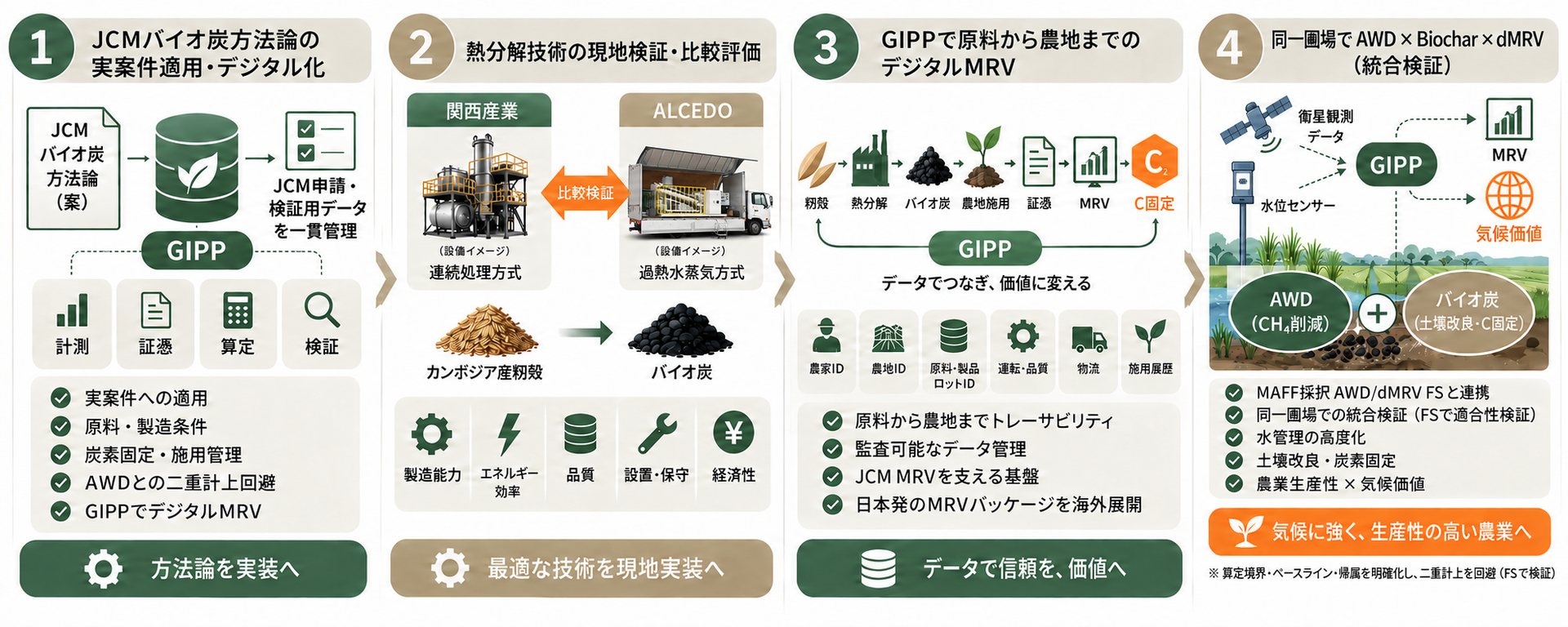
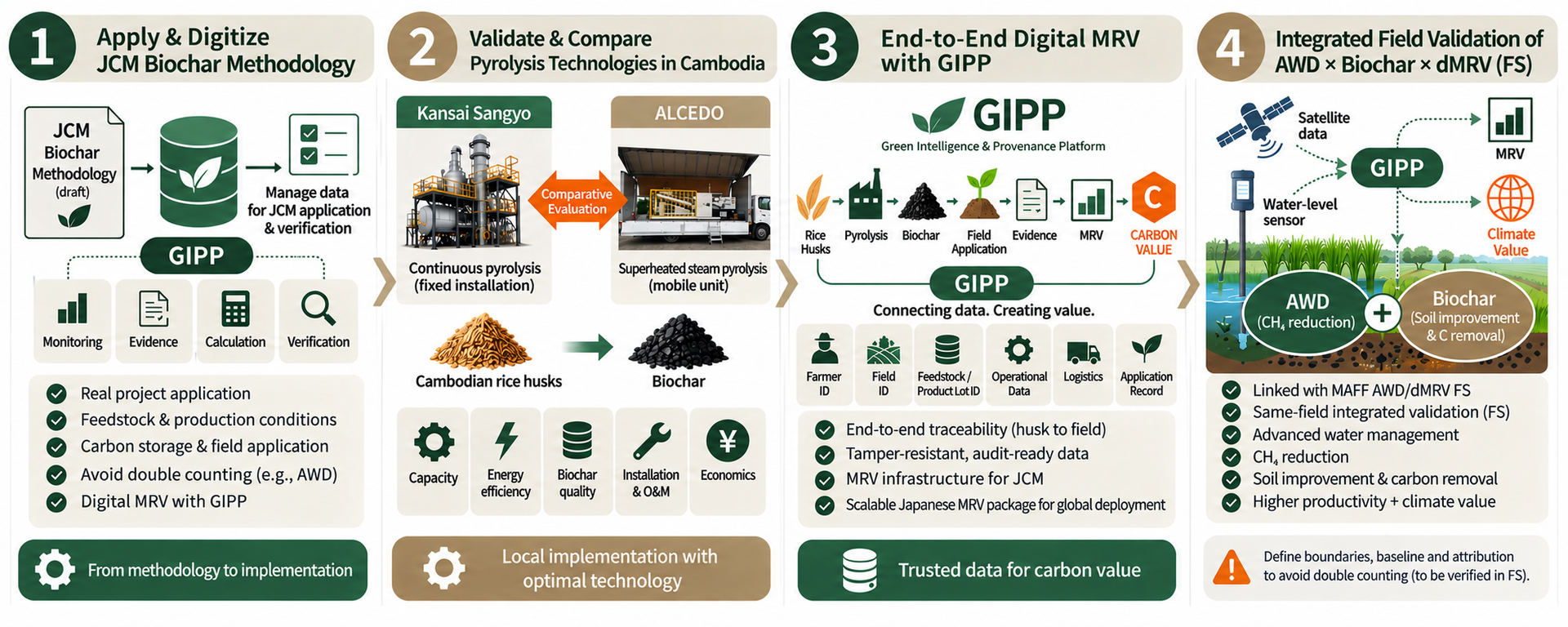
Building on a draft JCM biochar methodology being developed by Nippon Koei Co., Ltd. under a METI-commissioned study, the project will define the requirements for applying the methodology to a real project in Cambodia. It will examine feedstock control, production conditions, quantification of carbon storage, field-application management and MRV design, including safeguards to avoid double counting with greenhouse-gas reduction activities such as AWD.
Looking ahead to field application of the methodology and its evolution into digital MRV, the project will integrate it with GIPP (Green Intelligence & Provenance Platform), developed by Asian Gateway, to implement digital MRV that provides end-to-end management of the data required for measurement, evidence management, calculation and verification. GIPP will serve as the digital infrastructure for organizing and managing the data and evidence required for validation, verification and credit-issuance procedures under the JCM.
2. Evaluating Pyrolysis Technologies from Kansai Sangyo and ALCEDO in Cambodia
Rice husks have high ash and silica content, making feedstock-specific pyrolysis conditions, equipment design and quality control important for producing biochar of stable quality. The project will evaluate, in parallel, the technical suitability of technologies from Kansai Sangyo Co., Ltd. and ALCEDO Co., Ltd. for Cambodian rice husks.
For Kansai Sangyo, the study will assess its carbonization and pyrolysis technologies, including continuous rice-husk processing, operating stability, biochar quality and the feasibility of installing equipment alongside rice mills. For ALCEDO, the study will assess its superheated-steam pyrolysis technology, including rice-husk pyrolysis characteristics, equipment specifications and suitability for local operation.
The two technologies will be comparatively evaluated in terms of production capacity, energy efficiency, biochar quality, installation requirements, maintainability and economics. The project will explore a local implementation model that applies Japanese companies’ pyrolysis technologies suited to Cambodian rice mills. Rather than exporting stand-alone equipment, it aims to integrate the pyrolysis systems with GIPP’s digital MRV infrastructure and establish an overseas deployment model combining “Equipment × Biochar Quality × Traceability × MRV.”
3. Digital MRV from Feedstock to Field through GIPP
GIPP will link evidence including farmer IDs, field IDs, rice-husk and biochar feedstock/product lot IDs, pyrolysis equipment operating data, biochar quality data, transport and storage records, field-application records and carbon quantification data. Through tamper-resistant and auditable data management, the project will secure traceability from feedstock to farmland and, over time, seek to deploy a Japan-developed “Rice-Husk Biochar MRV Package” in other countries and regions.
RICE HUSK → PYROLYSIS → BIOCHAR → FIELD → EVIDENCE → MRV → CARBON VALUE
4. Coordination with the MAFF-Selected AWD/dMRV FS: Toward Integrated Implementation of “AWD × Biochar × dMRV”
In parallel with this project, Asian Gateway is conducting an AWD (Alternate Wetting and Drying) implementation and dMRV feasibility study in Battambang Province as a selected FS under the Ministry of Agriculture, Forestry and Fisheries (MAFF) “Commissioned Project to Support Overseas Deployment of Decarbonization Technologies in the Agricultural Sector (FY2025 Supplementary Budget).” The FS examines AWD implementation and the feasibility of a dMRV system combining water-level sensors and satellite observation data.
The project team is considering, wherever feasible, using the same paddy fields for AWD implementation and the application of rice-husk biochar under this project, and evaluating an integrated agricultural model. By combining improved water management and methane (CH₄) emission reductions through AWD with soil improvement and carbon storage through biochar, the initiative aims to achieve both improved agricultural productivity and the creation of climate value.
For AWD dMRV, water-level sensors installed in paddy fields will be combined with satellite observation data. The sensors will continuously measure flooded and drained conditions at field level, while satellite data will be used to estimate and complement information on cropping, vegetation and inundation conditions over wider areas. These data will be integrated into GIPP to digitally document AWD implementation and build scalable dMRV infrastructure supporting the quantification and verification of GHG reductions.
WATER-LEVEL SENSOR + SATELLITE → GIPP → MRV → CLIMATE VALUE
* Integration of AWD and biochar in the same paddy fields is conditional on the FS confirming technical, agronomic and methodological compatibility, and on clearly defining the accounting boundaries, baselines and attribution of the two activities to avoid double counting.
Integrated Evaluation of GHG Reductions and Carbon Storage in the Same Paddy Fields
AWD targets “Emission Reduction” by reducing methane emissions from paddy fields, while biochar will be assessed for its potential to stably store biomass-derived carbon in soil and create future carbon-removal value. By clearly distinguishing the MRV boundaries, quantified impacts, baselines and attribution of the two activities and avoiding double counting, the project will separately evaluate the GHG-reduction value of AWD and the carbon-storage and potential carbon-removal value of biochar, with the aim of generating carbon credits under applicable schemes and methodologies.
The project will also evaluate the potential to increase yields, optimize agricultural input costs and improve farmer income by combining appropriate AWD water management with soil improvement through biochar application. Rather than treating carbon credits as an end in themselves, the guiding principle is to return a share of the resulting Climate Value to farmers by rewarding better agricultural practices.
Turning Battambang’s Rice Husks into a Local Resource
Battambang is one of Cambodia’s leading rice-producing provinces and generates large volumes of rice husks through milling. The project will assess how these rice husks can be upgraded into a higher-value local resource and transformed into a circular value chain: “Rice Husk → Biochar → Soil → Carbon Value.”
Over time, Asian Gateway aims to implement an agricultural model integrating AWD, biochar and dMRV in Battambang, establish a model capable of evaluating agricultural productivity, GHG reductions, carbon storage and farmer-income improvement in an integrated manner, and expand the approach to other major rice-producing areas in Cambodia and other Asian rice-producing countries.
Related Links
• Program website: https://r7h-gs-hojo-web-fspoc.jp/
• Selection results:
https://r7h-gs-hojo-web-fspoc.jp/assets/files/saitaku/saitakukekka_260630.pdf
About Asian Gateway Corporation
Asian Gateway Corporation is a GX integrator that develops and implements decarbonization projects primarily in Asia and South America by combining renewable energy, hydrogen, SAF, carbon credits, digital MRV and blended finance. The company advances decarbonization projects using the Joint Crediting Mechanism (JCM), international carbon markets and private capital.

Media & General Inquiries
Asian Gateway Corporation
Contacts: Okabe, Wakatsuki
E-mail: info@asiangateway.co.jp